
Pool Leak Detection in New Braunfels: Limestone, Clay & Slow Leaks
The short answer
New Braunfels pools sit on a mix of Hill Country limestone and clay that expands and contracts with Texas rainfall — creating slow, stubborn leaks that are easy to miss until real damage has set in. A pressure test and professional inspection pinpoint the source before you waste another month of water.
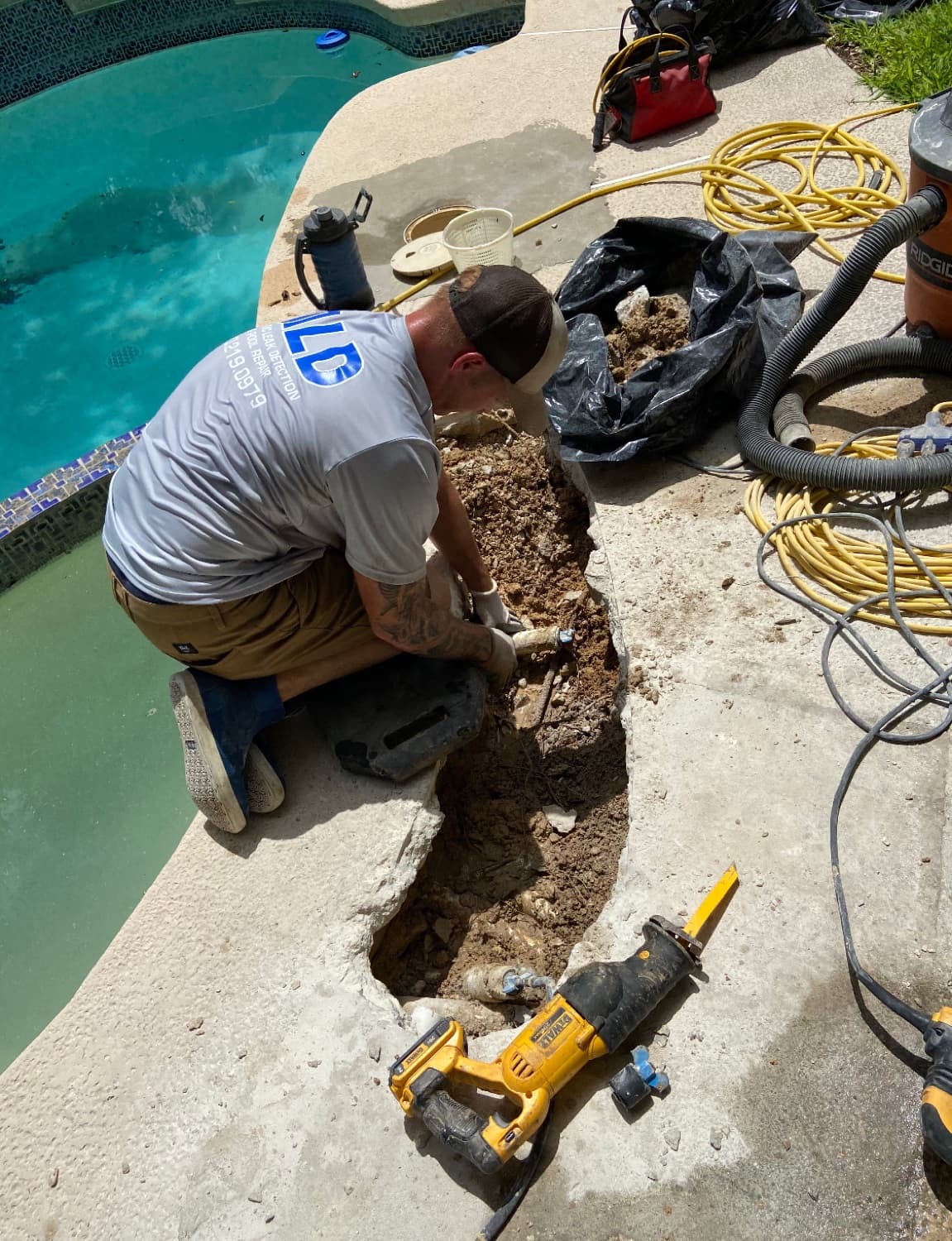
Why New Braunfels Pools Leak More Than Owners Expect
The ground underneath a New Braunfels pool is not a simple uniform layer. Comal and Guadalupe Counties sit where the Edwards Plateau meets the Gulf Coastal Plains, which means many yards have fractured limestone just below a layer of clay-rich soil. That combination creates two competing forces on a pool shell: the rock doesn't give, but the clay does — shrinking in a dry summer and swelling when the rains return.
Over several wet-dry cycles, that movement stresses the shell, the plumbing penetrations, and any fittings that cross the clay-rock interface. A crack that starts hairline-thin can widen slowly, or a main drain fitting can work itself just loose enough to lose water without ever showing a dramatic break. The result is a pool that seems to 'just use water' — no obvious crack, no puddle, but the level drops more than Texas evaporation alone explains.
How Much Water Loss Is Normal Here?
Texas evaporation is real. On a hot, breezy Hill Country afternoon, a pool can lose roughly 1/8 to 1/4 inch of water per day just to the air — more if you run a water feature or spa spillover. That's a normal baseline.
The bucket test is the simplest way to separate evaporation from a leak: fill a bucket to the same water level as the pool, set it on a step, and check both after 24–48 hours. If the pool dropped noticeably more than the bucket, that difference points toward a leak. If you're consistently losing more than 1/4 inch a day — especially after ruling out splash-out and auto-fill issues — it's worth calling for a formal pressure test before the slow water loss compounds into a bigger problem.
- Normal: up to ~1/4 inch per day from evaporation in summer heat
- Concern: pool losing more than the bucket at the same time
- Red flag: water loss continues even when pool is not running
- Red flag: soft or sinking ground near the deck edge or equipment pad
We test, we don't guess
Seeing this on your own pool? You don't have to figure it out alone — our techs pinpoint the exact source before anyone lifts a tool.
Family-owned · Licensed & insured · We answer the phone
Limestone Plumbing Lines: Where the Trouble Often Hides
In New Braunfels, the underground plumbing runs through — and over — limestone shelf rock. During excavation, builders often have to route lines around rock, which creates bends and joints that are vulnerable over time. When the clay above those lines swells after a wet spring, it can shift fittings slightly. When it dries out and contracts, the ground settles, sometimes unevenly.
Electronic leak detection and pressure testing isolate each plumbing line individually, so you can know whether you're dealing with a shell crack, a buried line, a skimmer, or a fitting — rather than guessing and digging in the wrong spot. In-house repair capability matters too: once the leak is found, it can go straight to fixing, without handing off to a separate contractor.
Gruene, Canyon Lake & the Surrounding Areas
Whether the pool is in a Gruene historic home, a newer subdivision off FM 306 near Canyon Lake, or somewhere in between, the local geology varies enough that the right approach depends on what's actually under that yard. Pools near the Guadalupe River bottom tend to sit on softer alluvial soil, which is more susceptible to shifting. Pools on the higher-elevation limestone ridge experience different stress — more settling at the shell perimeter, more wear on skimmer throats.
A qualified technician who's familiar with these county-level soil patterns knows which areas call for extra attention to the shell versus the plumbing. That local knowledge shortens the diagnostic process considerably.
What a Leak Detection Visit Looks Like
A professional New Braunfels pool leak detection starts with a full visual inspection — the deck, coping, skimmer boxes, equipment pad, and any visible fittings. From there, each plumbing line is pressure-tested individually to isolate where pressure holds and where it doesn't. Electronic acoustic listening equipment can then narrow the location of a buried leak without tearing up the deck speculatively.
If the shell or fittings are suspect, an underwater inspection confirms whether any cracks, delamination, or loose fittings are contributing. The goal is a specific, confirmed answer — not a range of possibilities — so the repair is targeted and the work doesn't get repeated.
When to Call vs. Watch and Wait
Not every water-level drop needs an emergency visit. If you've just opened the pool after a long off-season, or if New Braunfels had a streak of hot, dry, windy days, run the bucket test first and give it 48 hours. If the pool is consistently dropping more than the bucket — especially outside of summer peak evaporation — a professional test is the faster and cheaper path than months of monitoring and escalating water bills.
Early detection also prevents secondary damage. Water migrating under a deck or along a plumbing line can undermine decking, erode the supporting soil, and — in limestone-heavy areas — find its way into natural fractures that are much harder to address later.