
Is Your Texas Pool Losing More Water in Summer? Heat vs. Leak
The short answer
In peak Texas summer, heat and wind push evaporation to 1–1.75 inches per week — but a leak will outpace even that. The bucket test tells you which problem you have before you spend a dime.
Summer Evaporation Is Real — and Higher Than You Think
Pool owners across Texas notice it every June: the water level drops faster than it did in spring, and the auto-fill kicks on more often. That's not your imagination. Normal evaporation runs roughly 1/8 to 1/4 inch per day under typical conditions, but summer changes the math. In San Antonio and Abilene, daytime highs above 100°F, low relative humidity, and steady south-to-southwest winds all pull moisture off the surface at once.
A hot afternoon with a stiff breeze can push daily evaporation toward the high end of that range or beyond. Over a week that adds up — a pool losing an inch and a half isn't automatically alarming in July. The problem is that a slow leak can hide inside that normal summer range, which is exactly why homeowners ignore a real leak for months before the water bill finally forces the question.
What Makes Texas Summers Especially Aggressive
The combination of heat and low humidity is key. Gulf Coast humidity helps — moist air above a pool slows evaporation somewhat. But move west into Abilene or Midland and the air is dry. A pool that loses 3/4 inch per day in West Texas during a heat wave is losing far more water than the same pool would in a humid coastal climate. San Antonio sits somewhere in between: humid enough in early summer, but once a high-pressure ridge parks over Central Texas in late July and August, humidity drops and evaporation climbs.
Wind matters more than most people realize. Wind strips the humid layer of air that naturally forms just above a pool surface. Exposed pools in open backyards — common in newer Stone Oak and Helotes subdivisions where tree coverage is limited — lose water faster than pools sheltered by walls, covered patios, or mature trees. A pool in a windy corner of a yard can lose noticeably more than its neighbor's pool two streets over.
- Temperatures above 95°F combined with low humidity accelerate surface evaporation
- Prevailing south and southwest winds in summer strip the humid microclimate above the pool
- Uncovered pools, especially in open backyards, lose the most water to evaporation
- Heated pools and spas evaporate even faster — the warmer the water, the higher the vapor pressure
We test, we don't guess
Seeing this on your own pool? You don't have to figure it out alone — our techs pinpoint the exact source before anyone lifts a tool.
Family-owned · Licensed & insured · We answer the phone
The Bucket Test: Your First Move Before Calling Anyone
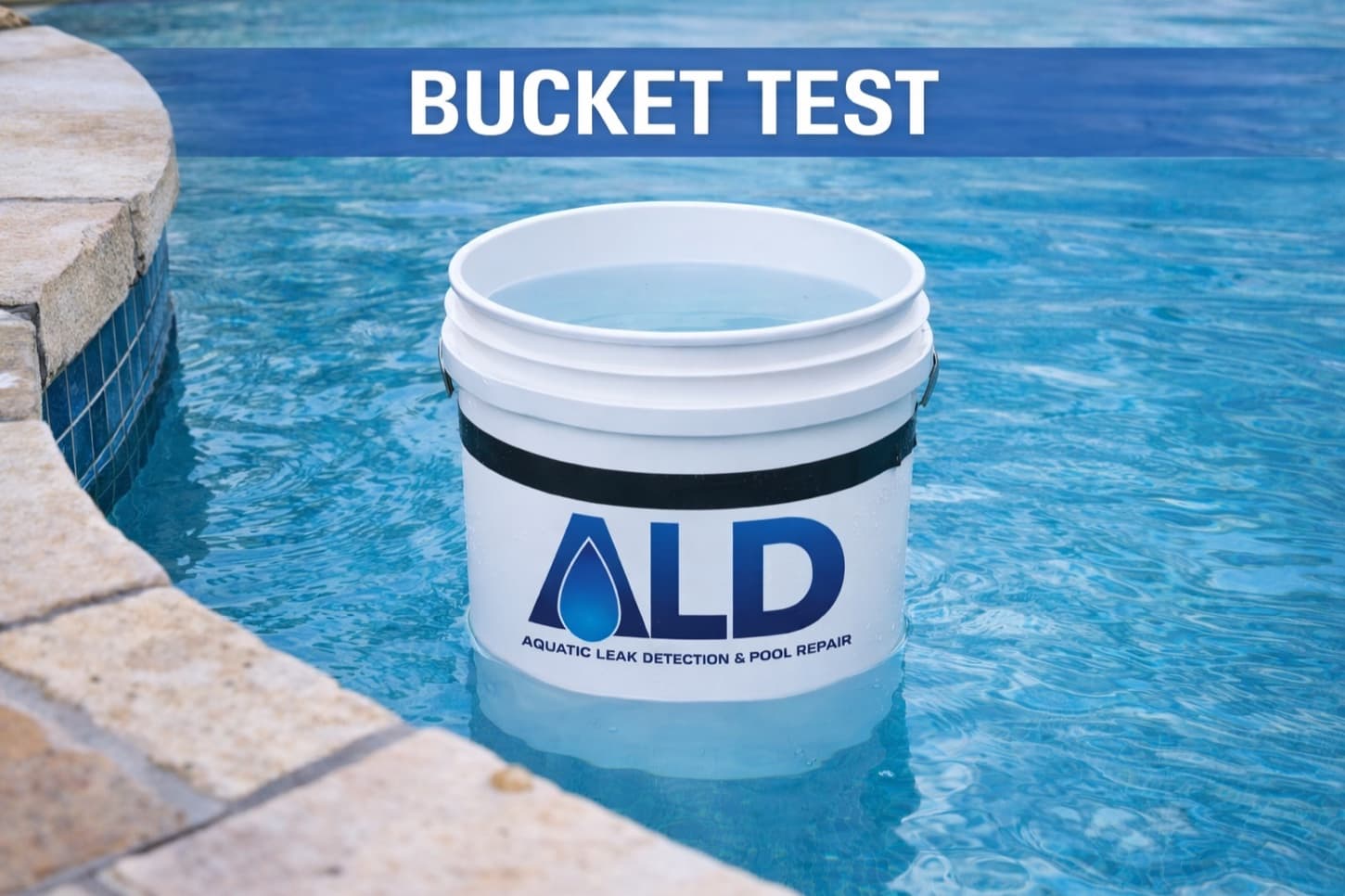
The bucket test is a simple way to separate evaporation from a leak, and it works in any season — but it's especially useful in summer when evaporation is at its peak. The idea is straightforward: you give the pool and a bucket of water identical conditions, then measure which one lost more.
Fill a five-gallon bucket with pool water until it matches your pool's water level. Set the bucket on a step so it sits in the pool water. Mark both the water inside the bucket and the pool water level. Leave the pump running normally. Check both marks after 24 hours. If the pool dropped roughly the same amount as the bucket, evaporation is likely the culprit. If the pool dropped significantly more than the bucket, you probably have a leak.
One important nuance: run the test with the pump on for 24 hours, then again with the pump off for 24 hours. A leak that gets worse when the pump runs points to a plumbing or pressure-side problem. A leak that stays the same with the pump on or off is more likely in the shell or fittings. This distinction helps any professional you call narrow the search.
When Faster Loss Means You Have a Real Leak
If your pool is losing more than 2 inches per week and the bucket test shows the pool dropping faster than the bucket, you're not looking at a summer evaporation spike — you have a leak. Even in the hottest, windiest Texas conditions, evaporation alone rarely exceeds that threshold on a properly covered pool. Without a pool cover, losses can run higher, but the bucket test will still show proportional losses.
Other signs that lean toward a leak rather than evaporation: you're adding water two or three times a week just to keep the auto-fill from cycling continuously; your water bill spiked significantly compared to the same month last year; you notice wet soil or soft ground near the equipment pad, along the return lines, or at the pool's edge; or the pool loses water faster at night than during the day — evaporation slows after sunset when temperatures drop, but a structural or plumbing leak runs continuously.
- Pool dropping more than 2 inches per week warrants a bucket test at minimum
- Wet ground or soft spots near the equipment pad, returns, or skimmer are red flags
- Loss that continues or worsens overnight suggests a leak rather than daytime evaporation
- An unexplained jump in the water bill during summer months can expose a slow leak
Texas Clay Adds Another Layer of Complexity
In San Antonio and Abilene, the soil is mostly expansive Blackland clay. During summer drought, that clay contracts as it dries — and it does not contract evenly. This seasonal movement stresses pool shells, underground plumbing lines, and fittings. A pool that was perfectly tight in spring can develop a slow leak by August simply because the ground beneath it shifted during a hot, dry stretch.
This is why a summer leak in Texas isn't always a construction defect or a maintenance failure. It may be a leak that opened up as the soil moved. Finding it requires pressure testing the plumbing lines and a thorough underwater inspection of the shell — not just eyeballing the water level and hoping for rain.
When to Call a Leak Detection Specialist
If the bucket test points to a leak, or if you're uncomfortable running the test yourself, a professional leak detection company can pinpoint the problem without guesswork. Aquatic Leak Detection uses electronic listening equipment, pressure testing, and underwater inspection to locate leaks in the shell, plumbing, and fittings before any digging or repair begins.
It's worth calling sooner rather than later in summer. A slow leak that goes unaddressed keeps your pump running to maintain level, drives up your water and chemical bills, and can erode the soil under and around the pool shell. In Blackland clay, an undetected leak can accelerate the very soil movement that caused it — a cycle that gets more expensive the longer it runs.